
Data retention and compaction
How long your books keep every entry and document, keeping them longer or for good, and the archive of each compaction.
Your books keep every entry and document in detail for as long as the tax rules require. After that, Adimone compacts the oldest years: their detail is summarized and removed, so the books stay fast however many years you use them. Open Data retention (in the menu, under Business) to see where your business stands.
The owner and administrators can open the page; only the owner can change it.
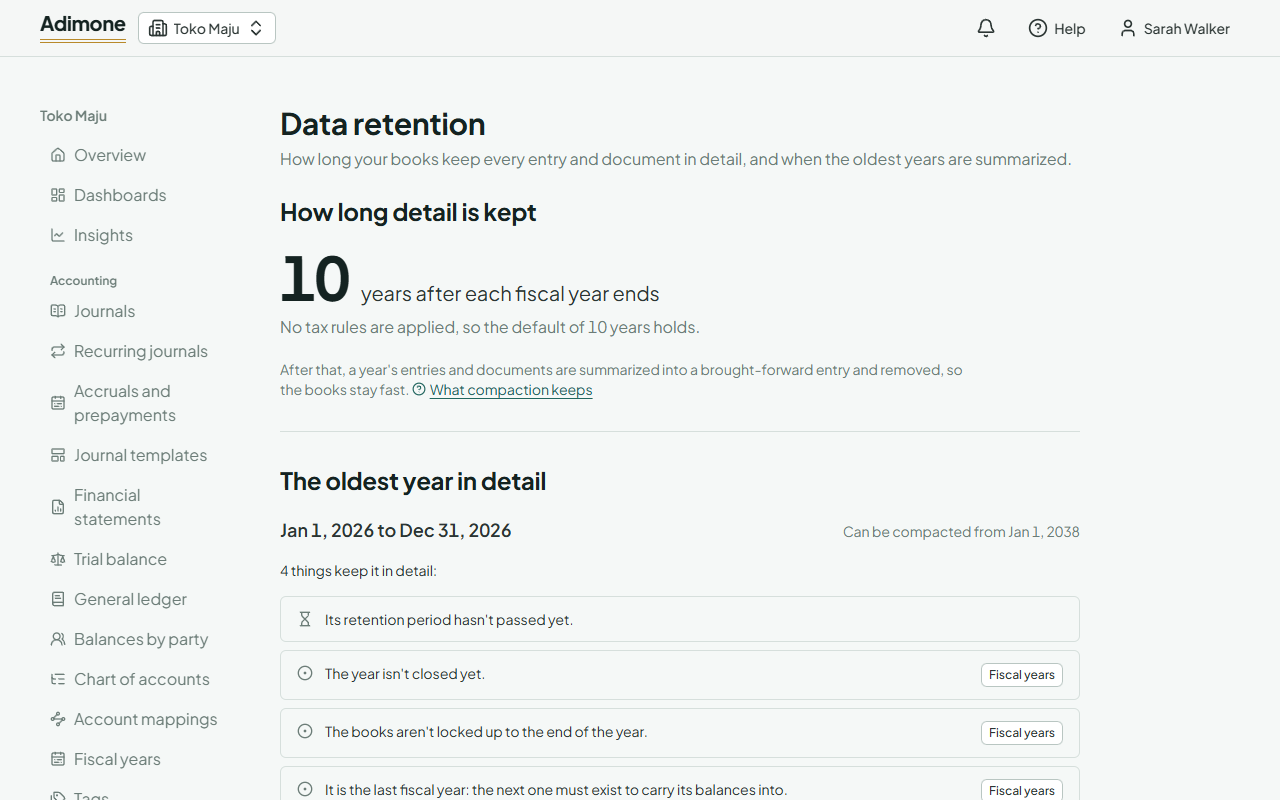
How long detail is kept
The big figure is how many years after a fiscal year ends its detail is kept. For a business it comes from the tax rules you applied in Taxes: Indonesia's rules keep books, source documents, tax invoices and payroll records for 10 years each. Without tax rules, 10 years hold. Nobody can go below what the rules ask.
A business gets a year of grace on top, so a year that ended on 31 December 2024 is compacted no earlier than 1 January 2036.
A personal workspace keeps 5 years of detail unless you choose between 2 and 10.
Keep detail longer, or for good
Under Keep detail longer, the owner can:
- add Extra years, up to 20, kept on top of what the law asks; the bars show each record class with the years you added;
- turn on Never compact to keep every year in detail, however old. The books grow and get slower over the years. It also cancels a compaction that hasn't finished.
Choose Save changes. Both can be changed back at any time; the change history can undo them too.
The oldest year in detail
This shows the oldest fiscal year still in detail, the first day it may be compacted, and anything that keeps it in detail:
- its retention period hasn't passed yet;
- the year isn't closed: close it in Fiscal years;
- the books aren't locked up to the end of the year: move the lock date;
- it is the last fiscal year: add the next one, which receives its balances;
- you opted out of compaction.
A year is never compacted while one of these holds.
How a compaction runs
When nothing holds the oldest year any more, a compaction starts by itself, at night:
- Notice. The owner and administrators get an email, and the compaction waits 90 days. To stop it, keep detail longer or opt out; reopening or unlocking the year stops it too.
- Balances carried forward and checked. The balances at the cutoff are posted as one brought-forward entry, and open invoices and bills are carried with what is still owed.
- Detail archived and verified. Everything about to be removed is written to the archive and read back.
- Detail removed.
- Books checked again, and an email says it is done.
The page shows the step a compaction is on. A step that fails is tried again every night; nothing is lost in the meantime, and the administrators are alerted after three failures in a row.
What compaction keeps
- The brought-forward entry with every account's balance at the cutoff, and the year summaries.
- Open invoices, bills and their balances, so you can still collect and pay them.
- Reports, the trial balance and the general ledger start on the cutoff; nothing can be posted before it.
The archive
Under Compactions, every compaction lists its dates, how many records it removed and its archive. Download archive gives a ZIP of everything it removed: one file per kind of record (journals, invoices, bills and so on), one record per line, with a manifest that lists each file's checksum and record count, signed by Adimone so you can show it wasn't changed. A very large business gets its archive in parts (Part 1 of 2, Part 2 of 2); download each.
Keep a copy somewhere safe: the archive is deleted 90 days after the compaction. Each download is recorded in the audit log.