
How stock is costed
Moving average or first in, first out, what stock coming in and going out costs, and the journals stock documents post.
Every move of stock has a cost, in your base currency. What stock on hand cost is its value, and it always equals the balance of your inventory accounts.
Choose the costing method
On Warehouses, under Costing method, whoever keeps the books chooses:
| Method | Stock going out costs |
|---|---|
| Moving average | The average cost of what is on hand in that warehouse. Simple, and what most small businesses use. |
| First in, first out | The cost of the oldest stock first. Close to how goods actually move. |
Choose before stock first moves: after that, the method is fixed and the page says so.
What stock costs
- Coming in: the unit cost entered on an adjustment line (and later the purchase price on a receipt). Without one, the average cost on hand, else the last cost, else the item's purchase price.
- Going out: by the costing method. A transfer carries its cost to the other warehouse. A void puts stock back at what it cost.
Costs, values and unit costs are shown only to people who see purchase prices (Who sees purchase prices); others see quantities only.
Stock below zero
A sale at the till can take out more than is recorded on hand, for example when goods are sold before their delivery is entered. What goes out beyond what is on hand is costed at the item's last cost (else its purchase price), and the quantity shows below zero.
When stock coming in brings the quantity back to zero or above, what it cost becomes the value of the stock left on hand. The difference between what the shortage was costed at and what filling it cost is a costing variance: the app posts it to cost of goods sold against your inventory account, dated the day the stock came in. These journals show in the journal list with the source Costing variance, and the item's moves show it as a line without a quantity, naming the record whose stock filled the shortage (a refund at the till, a stock adjustment) with a link to it; the journal links to that record too. If a document dated earlier changes the shortage, the variance is worked out again like any other cost.
The journals of stock documents
Posting an adjustment or a count posts a journal of the value that changed, dated the document's day:
| Reason | Against your inventory account |
|---|---|
| Damaged, expired, lost, stolen, and count differences | Shrinkage (inventory adjustments when your chart has none) |
| Opening stock | Opening balance |
| Found, correction, other | Inventory adjustments |
The inventory account is the item's own, else its category's, else the one your account mappings name. Transfers post nothing: the value stays in your inventory. A void posts its own journal on the void's day. Open a document's journal from its page, or filter the journal list by Stock document.
The valuation report
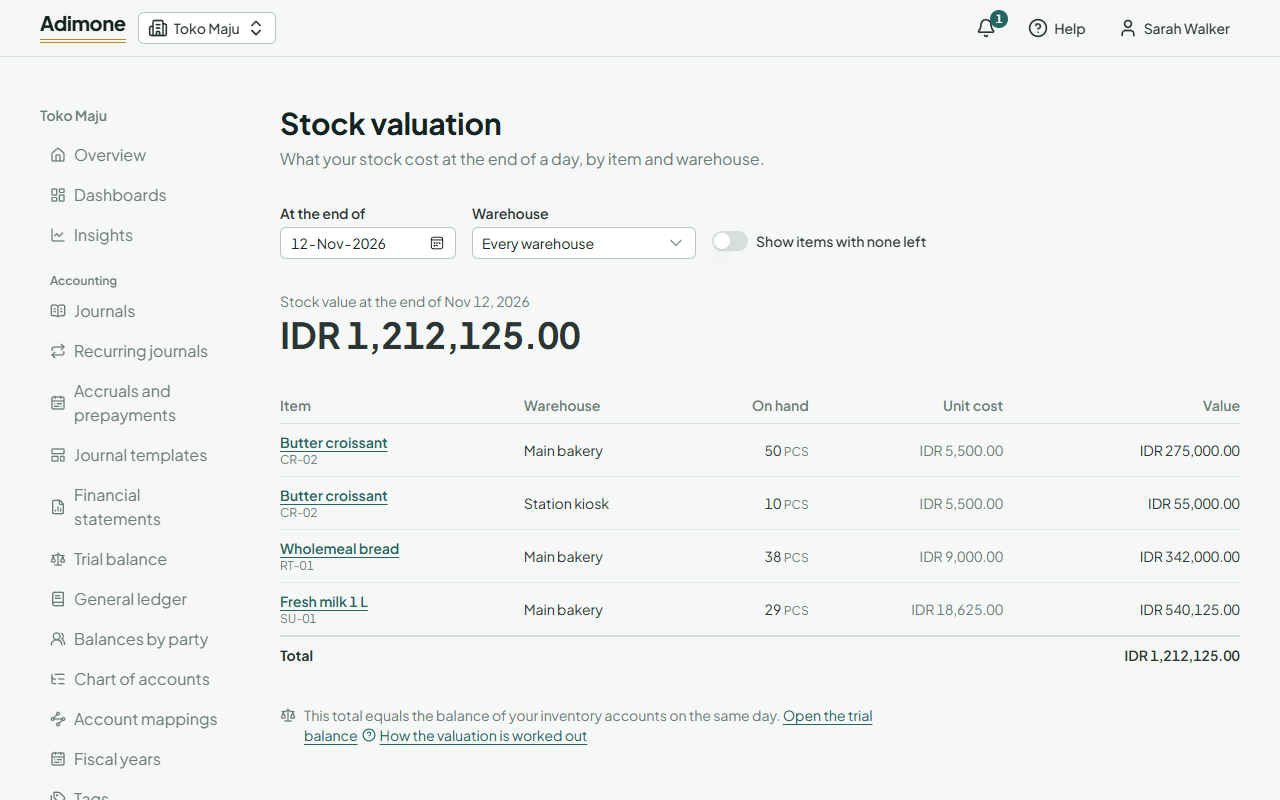
Stock valuation in Inventory shows what your stock cost at the end of a day: each item's quantity, unit cost and value in every warehouse, and the total in your base currency. Pick the day under At the end of, and a Warehouse to see one. Choose an item to see its moves up to that day.
The total equals the balance of your inventory accounts on the same day, so you can check one against the other in the trial balance. Only people who see purchase prices can open the report, and each time it's opened is recorded in the audit log.
When your oldest years have been compacted after their retention period, moves and the valuation start at the first day still kept in detail.
Documents dated before others
You can post a stock document dated before documents already posted, such as stock found last week. Its stock changes what later stock cost, so the app works out the costs of the later moves again and posts a journal of each difference, dated that record's own day. These journals show in the journal list with the source Stock re-costing. They follow the stock moves: to undo one, void the document that caused it.
A document can't change costs on a day your books no longer take (before the lock date, or in a closed period). Posting it then is refused with the day it would change: reopen that day, or date the document later.